


Mobility Aids: Tools With a Trade-Off
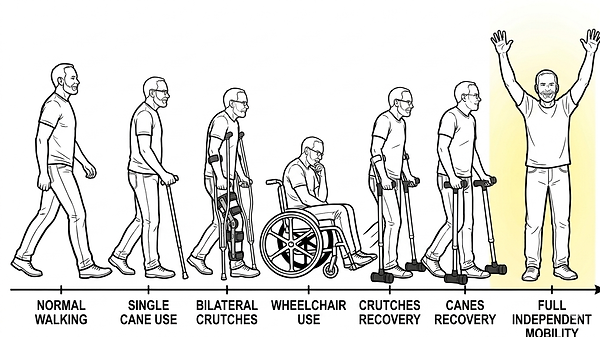
The Evolution of Me (2004-2026): Darwin didn't see this coming
The image above is my version of the evolution of man diagram. Except mine goes in both directions. Over 22 years with MS, it feels like I have used almost every time of mobility aid there is. At diagnosis in 2004, I was a mountain biker, trail hiker, and gym rat. What followed was a long arc of declining and then rebuilt mobility — intermittent cane use, then full-time cane, then a KAFO brace, then forearm crutches, then a manual wheelchair eleven years after diagnosis.
I was told I would be unable to walk or travel after age 50. While I fought hard to prevent it, MS was a grind. I was wheelchair dependent from age 51-56.
Now at 60, I have been out of the wheelchair and rebuilding for five years and counting.
The Decline
My mobility impact came fast. The mountain biking was the first to go. While I loved the Appalachian single-track trails, emerging balance issues caused frequent crashes. Recognizing breaking my neck would cause bigger mobility issues, I refocused on trail hiking. For a few years, trekking poles, tight-laced boots, and good friends were enough to overcome worsening foot drop and leg issues. And then they weren't.
I was using a cane four years after diagnosis and two years later, a rigid KAFO brace on my right leg. I was wheelchair-dependent 11 years post diagnosis. Charting my decline on the MS Severity Status Scale, I was tracking in roughly the 90th percentile.
my disability kept me off of the mountains, I kept going to the gymFor a while, I alternated between the manual wheelchair and customized forearm crutches depending on where I was going. As distance became an issue, I added a power wheelchair.
The Rebuild
Recovery has been gradual and nonlinear. Then as my inflammation came down and physical therapy went up, the wheelchairs became increasingly optional. I was back to forearm crutches. Then bilateral canes. Today, depending on my MS variables, I use one or two canes for distance — and often walk without any aid at all. I even did a short jog with my dog.
Mobility aids are valuable tools. They allowed me to be in places I simply would not have been otherwise. My forearm crutches let me cover 17 miles touring Europe — a continent that is spectacularly wheelchair-unfriendly — and I don't regret a single step. But they have a trade-off that nobody warned me about.
The problem wasn't the aids themselves. It was how I used them.
For years my approach to mobility was simple: go as far and as fast as possible, regardless of form. If I was limping, dragging a foot, or listing heavily to one side, that was the price of distance and I was willing to pay it. What I didn't understand was that every compromised step was also a neuroplastic event — the brain logging and reinforcing that distorted pattern as the new normal.
Compensating for foot drop, I shifted roughly 60-70% of my weight onto my stronger left leg for years. The KAFO brace stabilized my right leg but also allowed it to weaken from disuse. The result over time was severely distorted posture — walking off-balance, leaning left, pain compounding on pain. The wheelchair changed my body composition. The forearm crutches loaded my arms and shoulders in ways they weren't designed to sustain long-term.
What I've learned, later than I should have, is that good form beats fast or far. Every time. A slow, bilateral, quality step — left, right, left, right, like a marching band — does more useful neuroplastic work than twice the distance covered badly. Anything that deviates from that quality movement pattern comes with a steep cost over time, and the nervous system keeps the bill.
Today I estimate roughly half of the mobility issues I'm still working through are direct MS effects. The other half are byproducts of maladaptive compensation patterns built up over years of prioritizing distance over form.
Not a complaint — just a reality I didn't anticipate. If I had it to do again, I would have taken the aids off more often, slowed down sooner, and protected the quality of my movement even when it meant going less far and less fast. The aids solved the immediate problem. The form is what builds the recovery.


